All articles

Calculated vs Flat Rate vs Free Shipping on eBay

Flippedit Team Nov 22, 2026 8 min read

Shipping is the part of eBay that scares new sellers most. You've found the item, taken the photos, written the title, and then eBay asks you to pick a cost type. Calculated? Flat rate? Free shipping?

Pick wrong and a $30 sale can turn into a $2 sale.

Flippedit co-founder Matt has been selling full-time on eBay for over five years, and he covers this on his YouTube channel, The Aussie Flipper. This post uses his words and his examples, plus a few worked numbers of our own, so you can pick the right option for your next listing.

One note first: Matt sells in Australia, so his videos use Australia Post and the word "postage". In the US you'll see USPS, UPS and "shipping". The buttons look a little different, but the three options work the same way everywhere. His prices are in Australian dollars.

The three options in one line each

  • Calculated: eBay works out the shipping price from the parcel's weight and size and where the buyer lives.
  • Flat rate: you set one shipping price, and every buyer in the country pays it.
  • Free shipping: the buyer pays nothing extra, and the shipping cost comes out of your item price.

Calculated shipping: the safe choice for your first sales

Watch: Matt compares calculated and flat rate (starts at 5:20)

In his beginner shipping video, Matt lists a Slim Dusty CD. He wraps it in bubble wrap, slides it into an extra small padded mailer, and weighs and measures the package, not the product: 220 g, 26 Γ— 21 Γ— 7 cm.

As soon as he types those in, eBay shows a price range. Depending on where the buyer lives, the label will cost between $7.28 and $9.51.
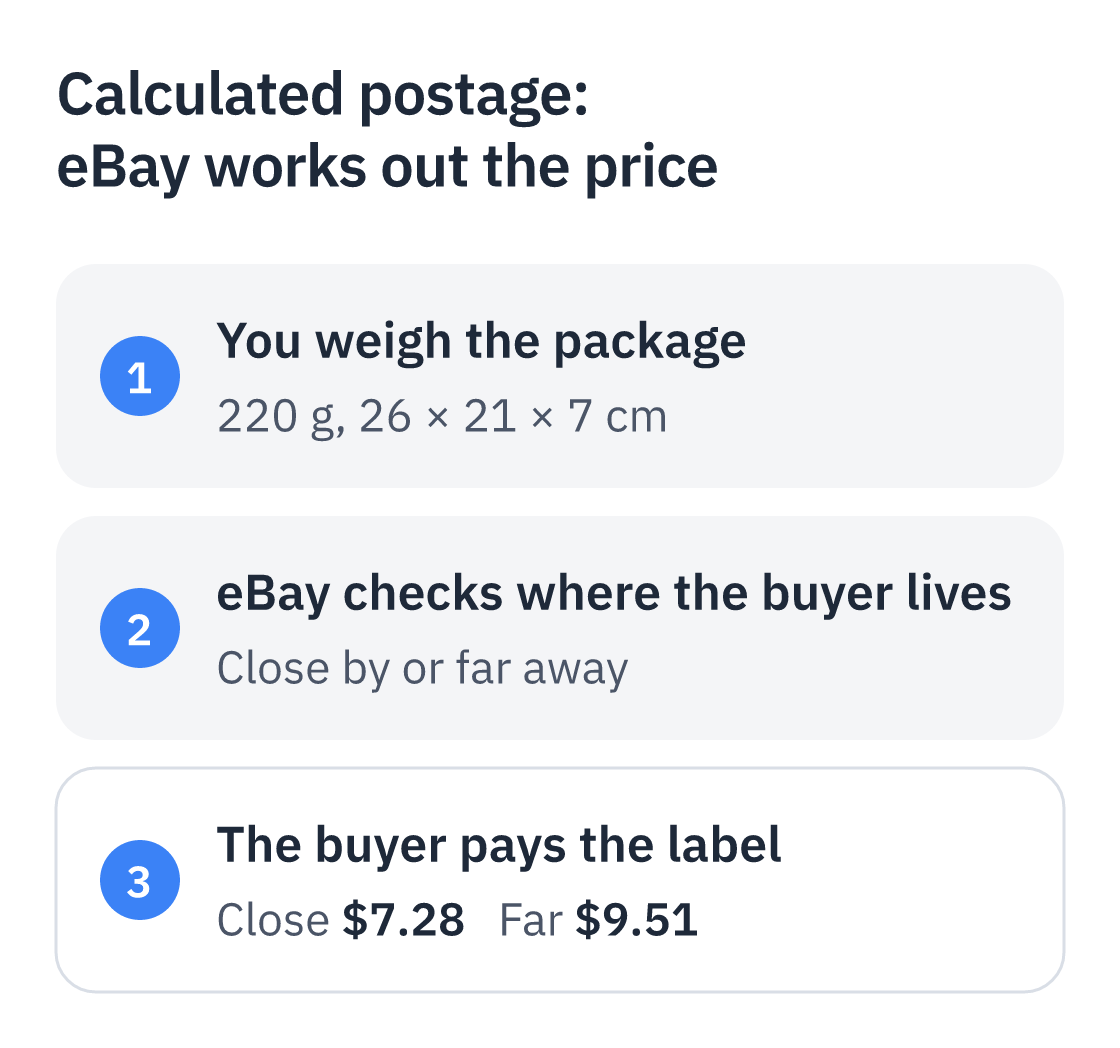
Calculated postage: you weigh the package (220 g, 26 by 21 by 7 cm), eBay checks where the buyer lives, and the buyer pays the label: $7.28 close by or $9.51 far away.

Here's how he sums up the two charged options:

"Flat rate means that we choose the price point no matter where it goes around the country... having this calculated option is going to be the safest way to not lose money."

Why is it the safest? Because the buyer always pays what the label actually costs. A buyer down the road pays $7.28. A buyer on the other side of the country pays $9.51. You never cover the difference.

What you need: a set of kitchen scales and a tape measure. Matt says these are the two things to buy before your first sale.

How Matt priced the CD

He'd researched the CD before listing and knew it sold for about $30 all in. So he didn't list it at $30 plus postage. He listed it at $19.95, because the buyer would add $7 to $9 of postage on top:

Close Far away
Item price $19.95 $19.95
Calculated postage $7.28 $9.51
Buyer pays $27.23 $29.46

Both totals sit just under $30, which keeps the listing competitive with other copies of the same CD. That's the habit to copy: decide the total a buyer will pay, then take the postage off to get your item price.

Flat rate: simple, but you carry the risk

Flat rate is one number for every buyer. It looks tidy on the listing, but someone has to cover the gap between your flat rate and the real label cost, and that someone is you.

Say you charge a flat $8 for the CD. A close buyer's label costs $7.28, so you make $0.72. A far-away buyer's label costs $9.51, so you lose $1.51.
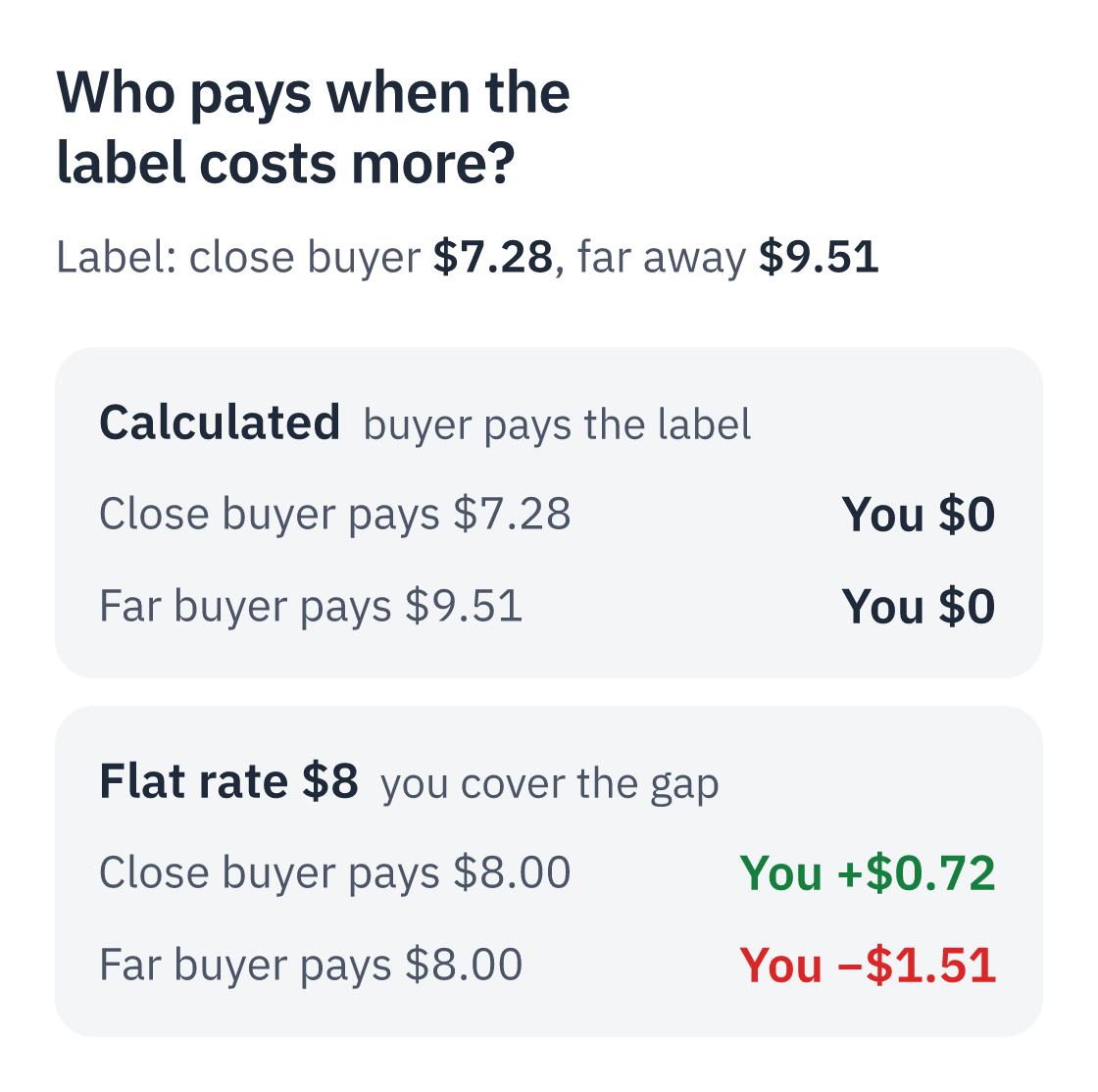
Calculated vs flat rate. Calculated: the buyer pays the label, $7.28 or $9.51, and you pay $0 either way. Flat rate $8: both buyers pay $8, so you make $0.72 on the close buyer and lose $1.51 on the far-away buyer.

On a small CD that's no big deal. On a heavier item, Matt warns the difference between close and far can be $10 to $20. Charge a flat rate on the low side and every far-away sale eats your profit. Charge on the high side and close buyers see a shipping price that looks too expensive.

When flat rate makes sense: the item costs the same to post anywhere, like a prepaid satchel or envelope, or you've sent enough of that item to know the real cost.

Don't mix up the two meanings of "flat rate". eBay's flat rate cost type is the price you charge the buyer. Carriers also sell flat rate boxes and satchels (USPS Flat Rate, Australia Post flat rate satchels), which is the service you post with. In Matt's video he picks the Australia Post flat rate extra small satchel as the service, but keeps the cost type on calculated. You can do both.
First-time offer

Your first month, 10% off.

Get a discounted signup link in your inbox. For first-time signups on the monthly plan.

Free shipping: it isn't free

Watch: Matt explains why free postage isn't free (starts at 5:47)

This is the question Matt gets asked most. People see his listings and ask why he gives away profit with free postage. His answer:

"It's not free postage. It's purely a marketing tactic."

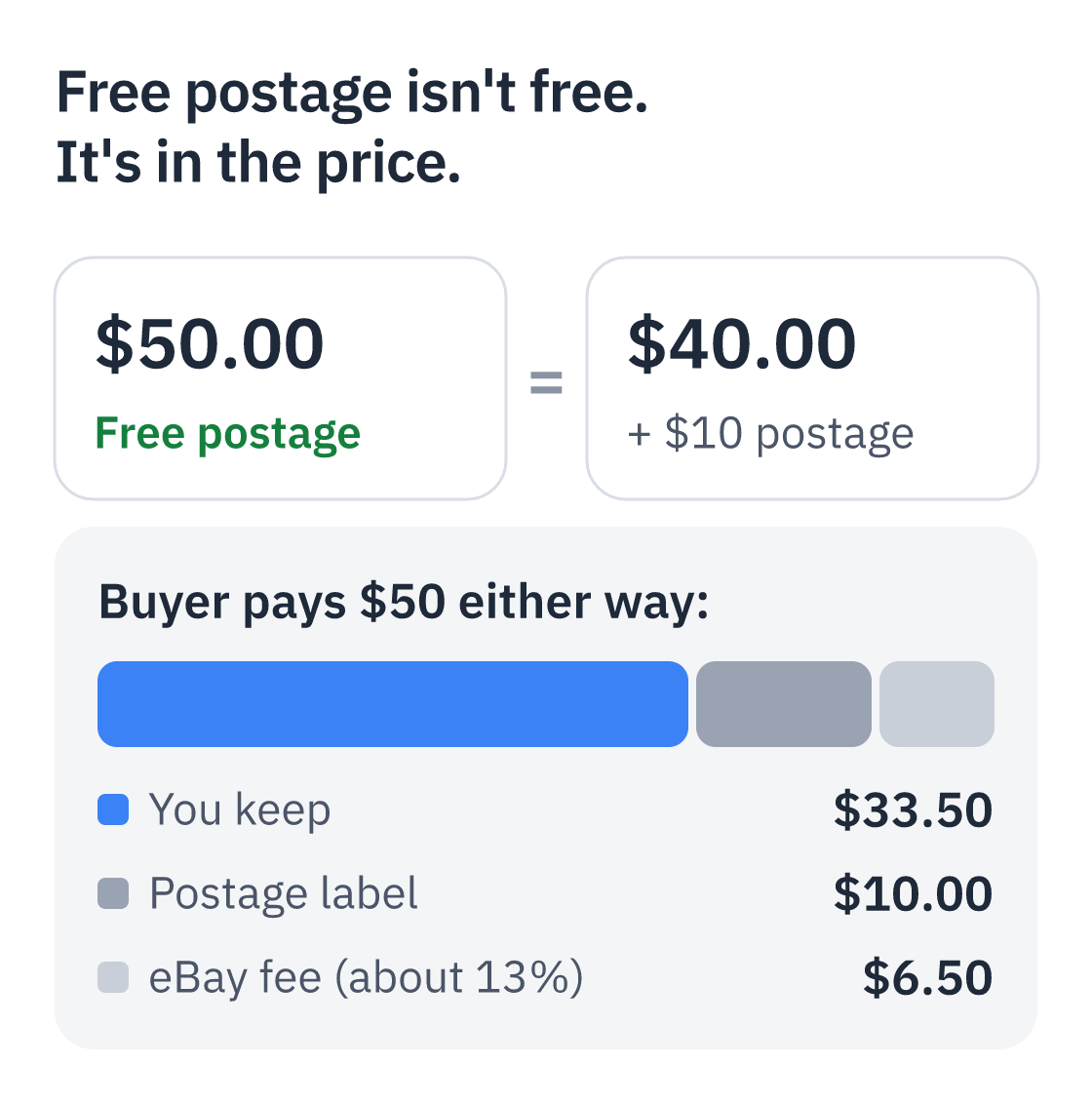
His example is a $50 product. You can show it two ways:

  • $50 with free postage
  • $40 plus $10 postage

The buyer pays $50 either way. Let's run the numbers, assuming eBay's fee is about 13% (it varies by category and country) and the label costs you $10:

Listing A at $50 with free postage equals listing B at $40 plus $10 postage. Either way the buyer pays $50: you keep $33.50, the label costs $10 and eBay's fee is $6.50.

Same money in your pocket (before what you paid for the item). eBay charges its fee on the total the buyer pays, postage included, so moving $10 from postage to the item price doesn't change your fees. (More on that in understanding eBay fees.)

So why bother? At an eBay event, Matt heard eBay say that 70% of eBay sales in the last quarter came from listings with free postage. Buyers filter for it, and a single price is easier to compare.

"As soon as I heard that, I've been free postage ever since, and my sales have been looking great."

The one catch: price for your most expensive buyer

With free shipping, the label cost changes but your price doesn't. If the CD costs $7.28 to post close by and $9.51 far away, build the higher number into your price, not the lower one. Round it up to $10 and you're covered for every buyer in the country.

Matt does this with prepaid envelopes. They cost $7.50 an envelope when he buys a pack of 10, so every DVD or video game that fits costs the same to post. For those he just sets free postage, because the cost is already known and fixed.

Which one should you pick?

Your situation Pick
First sales, not sure what parcels weigh Calculated
Heavy or bulky item, cost changes a lot by distance Calculated
Item always costs the same to post (prepaid satchel or envelope) Free shipping, cost built into the price
You know your postage costs and want more sales Free shipping, priced for the far-away buyer
You want a fixed shipping charge and the cost barely changes Flat rate

Matt is clear that his own setup isn't for beginners. He uses free postage, a business postage account and international shipping. For your first few sales he suggests:

  1. Calculated shipping, domestic only. Leave international off until you've made some sales at home.
  2. Three business days of handling time, so you have time to pack and print the label.
  3. A tracking number on every parcel. If a buyer says it never arrived, tracking is what wins you the case. A stamp doesn't.

Once you've posted a few dozen items and know what things really cost to ship, switch your small, light items to free shipping.

Check the profit before you list

Whichever option you pick, the question is the same: what do you keep after eBay's fee, the label and what you paid for the item? Put your numbers into the free eBay profit calculator before you list, and you'll know if free shipping still leaves you a profit. There's more on this in how to know your eBay profit before you list.

After the sale, Flippedit shows your real profit on every item, after fees and the postage you paid. If free shipping is eating your margin on heavy items, you'll see it per item instead of finding out at the end of the year.

Start your free 7-day trial and see what each sale really made you.

Keep reading.

Video guides

See where your eBay business stands.

Connect your account, check a few sales and see how Flippedit fits your working week.

Speak to Matt, our co-founder

Leave your number and a message. Matt replies on WhatsApp, not a bot.